Thursday, February 14, 2013

Teaching Pet Peeve

Teaching pet peeves, we've all got em!

One of my worst teaching pet peeves is when I explicit instruction on common errors or the "wrong way" to do something.


 I was mosing around on pinterest when I came across this chart:
 Pinned Image

I love this chart! EXCEPT for one thing. The big common error explination with a model. What we have to realize is that when we teach the wrong thing to do, we are still teaching it! Now, do I think we should never mention common errors? No. There may be a time and a place with a specific group of learners where we need to say it and say it in a direct way. But I don't think it's wise to repeatedly teach it or prominately display it for all to see everyday. It is entirely more meaningful to repeatedly teach the correct process. The goal would be to eventually cue learners through common errors rather than simply identify them.

For example, when I have a type of math problem where learners typically leave off the last step, I will work the entire problem up until that point. At which point I will say " Am I done?" The learners say "No!" I always respond "Why not?" Do you see how that might be more meaningful than repeatedly showing me the wrong way? What do you think?

And if you have a little extra time... Click the pic to compare student guesses with teacher responses.

Top 10 GUESSED Pet Peeves for Teachers:
1.    Chewing gum obnoxiously.
2.    Talking after they give you the shut-up look.
3.    Crazy excuses for not turning in homework.
4.    Giving the instructions, then having someone ask “What do we do?”
5.    Distracting noises.
6.    All of someone’s stuff on their desk.
7.    Someone slamming their locker when it’s not locker time.
8.    Running in hallways.
9.    Daydreaming in class.
10.  No one laughing at their jokes.

Click the pic for the full article

Wednesday, February 6, 2013

Mixed Numbers and Improper Fractions Posters

Here's a pic of some posters I made to help my students remember the process for changing mixed numbers or improper fractions. I'm halfway sad to post this as you can kinda see my ugly classroom walls lol.

Explanation-
To convert a mixed number to an improper fraction they must make the number "MAD" Multiply, Add, and Denominator.
To convert an improper fraction to a mixed number they have to multiply. Thus the cheer "With an improper fraction, division is the action!" It might be more fun with hand gestures :)

Tuesday, February 5, 2013

Text Mapping Non Fiction Text

I'm in love.

I'm in love with text mapping. I wish I would have came across this earlier in the year, but nevertheless, it's here and it's here to stay!


Text mapping involves marking non-fiction text in order to understand text features. It's a pretty specific system and I'm committed! Love it.

First of all, the text that will be mapped is presented in scroll form. Pages of the text are laid out in a sequence rather than a book style where they turn pages.

Old school
drawing of an open book.

New school
Drawing of a scroll that has been marked with highlighters and colored markers. Shows margin notes and certain key features circled, colored and otherwise marked.

You feelin' it yet?

And here's my beautiful take on scrolls. I found some old Boys Life and American Girl magazines in a magical closet in the school library. For the long, fancy, small group articles I ripped out the magazine cover and table of contents as well. I glued them to posterboard and voila! I eventually got lazy after 3 or 4 of these and stopped gluing them to posterboard. I'm having everything laminated so it really doesn't make much of a difference.


I also found some cool 2 page articles for independent/paired work.


Using text mapping is typically done in small group because it's hands on and very interactive. You could try it with a whole class, but I wouldn't do that to your self lol :) The scrolls are usually placed on the floor but I would rather have it on a white board so we could make notes. Like this:
Drawing of a Teacher marking scroll on blackboard. Shows notes scribbled on blackboard, some with arrows pointing to location in scroll, and other graphic markings.<---Can't do this on the floor. Advantage white board!
Photograph of a teacher kneeling on the floor, taping photocopied pages together to make a scroll.<--or lay it out. Note: This is not me! I had this up on my computer and one of my students was like "Miss, is that you?" :)

When we map it we are going to look for text features. This includes but is not limited to:
  • Headings & Subheadings
  • Captions & Sidebars
  • Bold print & Italics
  • Glossary, Index, and Table of Contents
At first we are going to use post-its (a lovely idea from my coworker Cobia!). I will give them post it's and ask them to identify text features. They can write what the text feature is and then place it on the scroll on the item. Example, place a "Heading" post it on the heading. They could also use multi colored dry erase markers if you laminate your scrolls.

We are going to incorporate several of our reading strategies including predicting, summarizing, and main idea vs. details. It's important to know what text features are how they work together. Be prepared for some tough times with the vocabulary. For example, some learners may have a hard time distinguishing a caption from a sidebar.

All images (other than the two from my scrolls) are from an the Text Mapping Project. Please visit their site at TextMapping.org

Monday, January 28, 2013

Expository Text

A few cool things for expository text. Additionally, I have this vague little writing assignment in my lesson plan for later in the week that I need your help for! I've seen a few writing projects, but I want one that's going to target all of the things we've talked about.

Teaching expository text should cover several things, including:
- Text structure. This can include comparison-contrast, sequence, or even cause/effect. Questions related to the structure are always included on standardized testing! An example from today would be why did the author write paragraph 2 before paragraph 3?
- Text elements. This has several parts. This might include bold words, italics, maps, graphics, sidebars, captions, etc.
- Purpose and use. Kids love procedural text but there's a lot more to it!

A few resources to share!

FREE Expository text question cards for before/after reading. Click here to download.
Pinned Image

I LOVE this FREE sheet to teach text structures! Visual! Yes! Click here to download.


From the same site as the above freebie, an awesome scramble and sort activity! Click here to get it.


Overall, this blog post pretty much rocks expository text and includes a ton of resources throughout with links to other resources at the bottom. Love it! Click here to visit.

Additionally, I have found several resources that I'm not choosing to post for one big reason, they just aren't particularly useful. I may have access to cute "Clue phrases" for text structure, but I've read what they will read. I've seen their tests. I've gazed into my teacher crystal ball and do not see any text that actually uses them. That sounds stubborn, but so be it. By the time they get to fifth grade they are expected to draw conclusions. It doesn't help them to give them training wheels they won't be able to take with them into a test. I'd rather spend our valuable class time learning how to analyze rather than teach them to look for clue phrases that aren't used much past 3rd grade. Know what I mean?

Let me know what you think!

Thursday, January 24, 2013

Mixed Numbers and Improper Fractions


This post literally took me 3 days to put together! So much stuff to share! I love it.

I'm going to start you off with the sequence that I'm using to teach this part of fractions. Our textbooks allow literally like, a day for this. But as we all know, I teach struggling learners. There aren't many things we can master in a day! So I'm breaking it up.

First Day- All about mixed numbers! We spend all of our math time on learning about mixed numbers and practice, practice, practice!
Second Day- All about improper fractions! We practice long and hard. At some point I pull in the work we completed yesterday and they write improper fractions for every mixed number they wrote. They've got to understand that the model stays the same and that there are two ways to write the fraction.
Third Day- Mixing it up. Bring in on grade level resources (including textbook). Learn the process for converting mixed numbers to improper fractions. We have gone through the steps a million times. After watching a video we do guided and independent practice on plain computer paper. Fold it into 8's and voila! I have them write the mixed number big with pencil. Then they go in and draw the multiplication and addition symbols with a highlighter. They do this over and over.

 If it helps, you can have them draw arrows with their highlighters.
Fourth Day- Still mixin'. Learn the process for converting improper fractions to mixed numbers. Bring in test style questions. How do our new skills help us answer a test question?

And now for the goodies! Let's start with videos.
Love this one. Teaches with and without a model. Teaches the process of converting.

This one is very, very basic and shows a demonstration of the process.


And now some other resources!

This is a poster guide that you can use to teach the process of converting mixed numbers to improper fractions. Make them M.A.D. (multiply, add, denominator)! Click HERE to view the article!

When you get ready to teach the process of converting improper fractions to mixed numbers, this site has a brief lesson and some practice worksheets for free! Click HERE to visit.
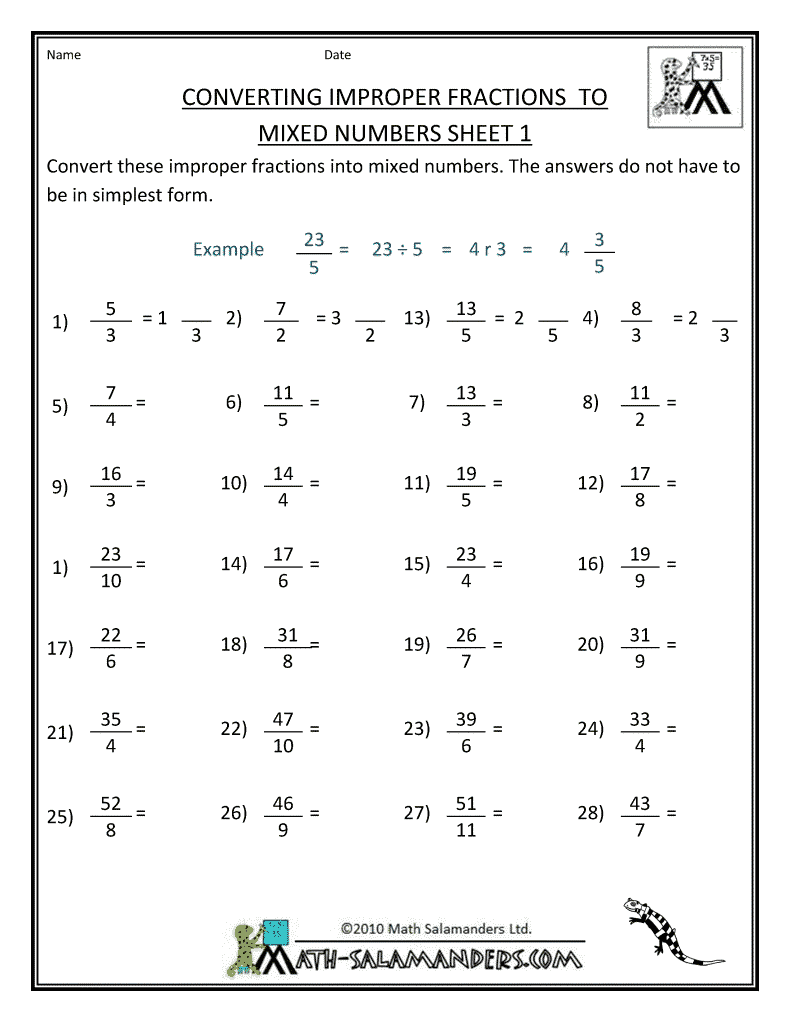
convert improper fractions to mixed fractions 1

Need some writing to learn ideas? Math journal ideas? Visit this page HERE

I found an AWESOME fraction word play activity. SO cool! It's fall themed but I seriously think it's too cool to care about. I might make my own. Love it! Click HERE to check it out!

Enjoy!

Wednesday, January 23, 2013

Fractions Sequence

I've been round and round with fractions for two years now and I've found that it's really important to have a good sequence for teaching fractions. When they get to 5th grade there are so many things about fractions they learn, it's hard to put things in order. Here's the best system I've come up with so far (in order):

Writing Fractions- If you teach mainstream, you may skip this. If you teach Special Ed. or the lower grades it's important to start with this. You may think they could look at a pizza cut into 6ths with two pieces missing and be able to write a fraction but you would be surprised! Teach the basic stuff. Give them plenty of practice. Give them a packet of examples and ask them to write the fraction. Talk about numerator and denominator. Go over vocabulary you might think is basic (this year I had to explicitly teach shaded and unshaded!). Teach all 3 types of fractions including whole (most textbooks call it a region), set (groups of like items), and segment (number line). Glance through my fractions posts to give you some awesome ideas!

Mixed Numbers & Improper Fractions- Again, give them LOTS of practice. Allow them to practice the basic skill of seeing a picture and writing both a mixed number and an improper fraction over and over before giving them test style questions.

Fractions & Decimals- Awesome resources to come! It's important at this point to circle back to the previously learned fraction skills.

Equivalent Fractions- Saved the hardest for last!

I hope this helps. Awesome resources to come!

Guide to Nightly Reading Response Log FREEBIE

If you teach a Special Ed. class (like me!) you know the value of your commitments to modified work. Many of your students might have a stipulation (formally known as a modification) that says their assignments must be modified. I'm diligent when it comes to modifying for my kids who have that specific modification. However, I hadn't considered modifying our weekly reading response. It's pretty straight forward, already calls for only a short answer response, and is usable across a few grade levels.